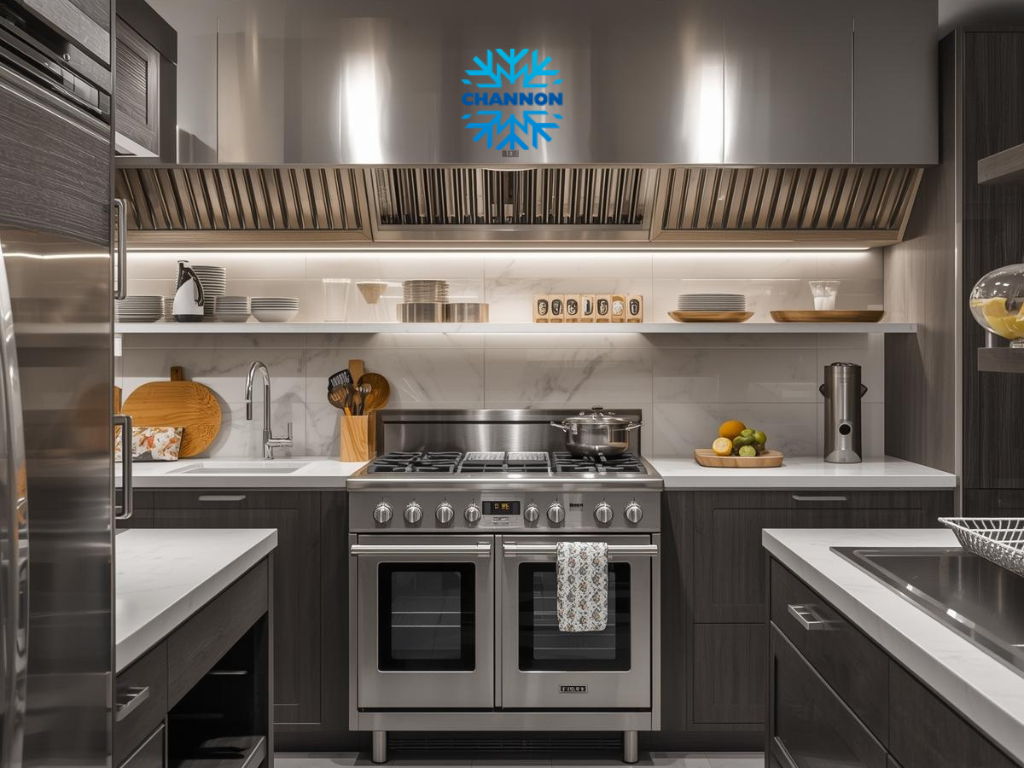
A commercial kitchen can contain excellent equipment and still feel difficult to work in.
The problem is often not the individual appliance. It is how the appliances work together.
A restaurant may have a powerful gas oven, yet staff still cross the kitchen to reach the fryer. Another venue may install too many appliances that perform similar jobs. This can take up valuable cooking-line space without improving service.
For businesses comparing commercial gas ovens, the better approach is to start with the menu.
Decide what the oven needs to cook. Then work out which jobs belong on the burners, griddle, fryer or another appliance.
Installation requirements also matter. NSW requires licensed gasfitters for gasfitting work, and current gas installations must follow the applicable regulatory standards.
Planning these details before ordering equipment can create a cooking line that better matches the way the kitchen actually operates.
List the cooking methods used during a normal service
Begin with the dishes rather than the equipment catalogue.
Look at how staff prepare each main menu item.
Some dishes may need roasting or baking. Others may need open burners for sauces and pans. Burgers, eggs or breakfast items may suit a flat cooking surface.
Fried foods create another requirement.
Write down the main cooking method for each menu group.
This simple exercise helps reveal what the kitchen actually needs.
For example, a restaurant that relies heavily on sauces, pasta and pan cooking may place more value on burner space.
A café with a large breakfast menu may need commercial griddles to handle several items at once.
Meanwhile, a venue serving roast dishes may depend more heavily on oven capacity.
Avoid buying equipment simply because another restaurant uses it.
The best cooking line should reflect your own menu.
Identify the busiest part of the menu
Next, think about demand during peak service.
A piece of equipment can handle normal trade but still become a bottleneck on Friday night.
Look at which dishes sell together.
For example, a burger venue may need the griddle and commercial deep fryer running heavily at the same time.
Another restaurant may depend on several burners while the oven handles roasting or baked dishes.
This helps you identify where extra capacity matters.
Do not assume every appliance needs to be larger.
Sometimes the better solution is to move one cooking task to another suitable appliance.
The goal is to keep several orders moving at once without staff competing for the same cooking space.
Decide What the Gas Oven and Range Need to Handle
A range with burners above an oven can combine two important cooking areas in one footprint.
A 4 burner gas oven may suit kitchens that need several pans on the range while also using an oven below.
Channon’s current catalogue includes several four-burner oven ranges. It also has a current Baron four-burner gas static oven range listed with four open burners above the oven.
However, burner count alone does not tell you whether the unit suits the kitchen.
Think about pan sizes.
Four small saucepans create a different space requirement from several large stock pots.
Also consider how often every burner operates at once.
A smaller café may rarely need all four burners. A restaurant with a pan-heavy menu may reach full burner capacity throughout service.
The oven below needs similar attention.
Ask what will cook inside it and how many trays or dishes you need to handle at once.
Match the range to real production needs rather than choosing by burner number alone.
Compare a standard range with combination oven options
A traditional gas range and a combination oven do different jobs.
A range gives cooks direct access to open burners, with an oven underneath on many models.
A combi oven focuses more on oven-based production and can use different cooking modes depending on the model.
Channon’s current combination-oven category lists both gas and electric combi models. Current examples include gas units from Convotherm and Rational.
If you are researching baron combination ovens, confirm the current models and availability directly with the supplier. Channon has previously published information about Baron combination ovens, while its live combination-oven catalogue currently contains a broader range of brands.
The right choice depends on the menu.
A kitchen that relies heavily on pans may still need a gas range even when it adds a combi oven.
In other venues, a multifunction oven may reduce the need for several separate oven-based appliances.
Compare cooking functions rather than assuming one oven type automatically replaces another.
Give Each Supporting Appliance a Clear Job
Use fryers and griddles where they improve workflow
A strong cooking line gives each appliance a specific role.
Consider fried food first.
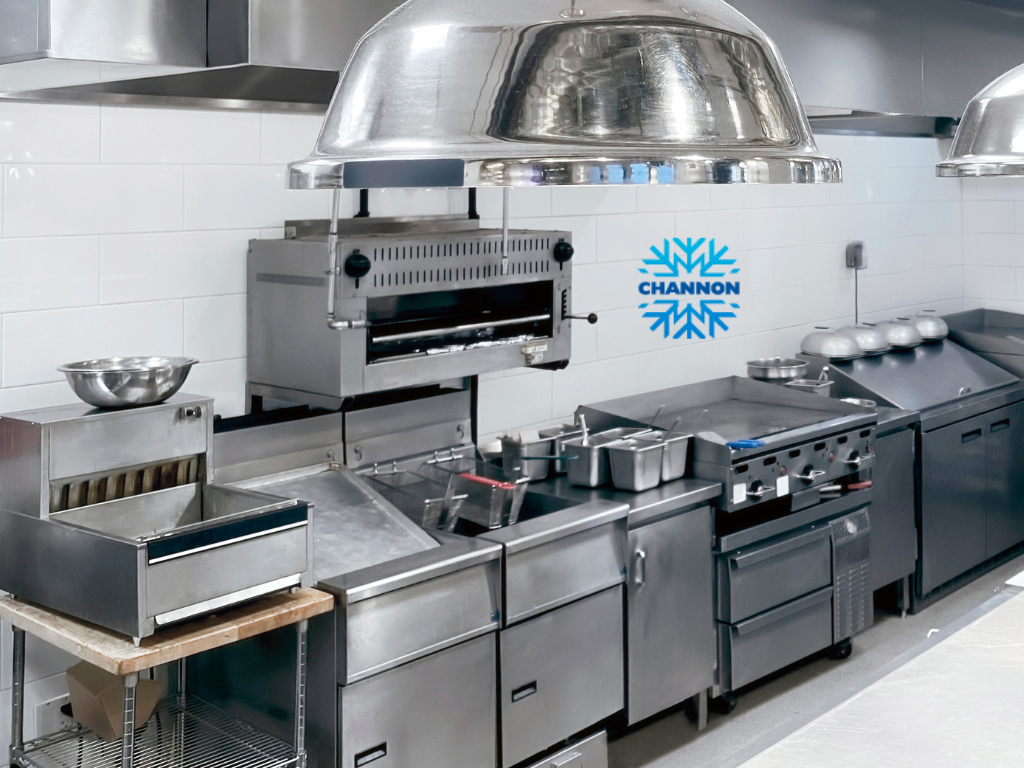
If chips, chicken or other fried products sell in large quantities, a commercial deep fryer can keep that work away from the oven and burners.
This prevents one cooking method from taking over equipment better suited to other dishes.
The same principle applies to commercial griddles.
A flat griddle can suit burgers, bacon, eggs, toasted sandwiches and other foods that benefit from a broad heated surface.
Using pans on every burner for these foods may not be the most practical use of range space.
Channon’s current product structure includes dedicated fryers and griddles alongside its ovens and cooktops.
Think about which appliance gives staff the simplest workflow.
The oven does not need to cook everything.
Often, a better kitchen uses several appliances for the jobs they handle best.
Decide where microwaves and rice cookers genuinely help
Smaller appliances can also remove pressure from the main cooking line.
A commercial microwave oven may help with specific reheating or fast-heating tasks.
It should have a clear role rather than becoming a substitute for a poorly planned main cooking system.
Channon’s current microwave category includes dedicated commercial microwave models from several manufacturers.
Commercial rice cookers can solve another specific production need.
For restaurants that serve large amounts of rice, moving rice production away from the burner line can free a burner for sauces, pans or stock pots.
Channon currently includes Rice Cooker within its commercial equipment categories.
Think of these appliances as support equipment.
They are most useful when they remove a repeated task from a more valuable part of the cooking line.
A microwave that is rarely used adds little value.
Likewise, a rice cooker may not make sense for a menu where rice appears only occasionally.
Check Gas, Power and Installation Requirements Early
A commercial gas appliance cannot be planned only around its physical dimensions.
The gas installation matters too.
NSW requires gasfitting work to be completed by an appropriately licensed person. Gasfitting includes installation, alteration, extension and repair of gas installations and related flue work.
Current NSW guidance also identifies AS/NZS 5601:2022 as part of the legally enforced framework for gas installations and appliances.
This means the gas requirements should be reviewed before the oven arrives onsite.
Provide the gasfitter with the exact equipment details.
Do not assume that replacing an old oven with a larger unit requires no changes.
Different appliances can have different gas requirements.
The equipment position also matters.
Manufacturer instructions, applicable clearances and the wider kitchen design all need consideration.
Since March 2026, NSW gasfitters must use BCNSW eCert for required compliance and inspection certificates.
Keep relevant installation records with the kitchen documents after the work finishes.
Plan electrical and other services for supporting equipment
A gas cooking line can still need significant electrical planning.
Microwaves, some combination ovens and other appliances need power.
A gas combi oven may also require an electrical connection for controls and other functions. For example, Channon’s current Rational CMP201-NG gas combi listing includes both a gas connection and an electrical mains connection.
Other equipment may need different services.
The exact requirements depend on the selected model.
Do not lock the cabinetry, walls or equipment layout before reviewing the specification sheets.
Check where gas, electricity, water or drainage may be required.
This is especially important during a new fit-out.
Moving a service point after construction begins can complicate the project.
Good equipment planning therefore needs to happen alongside the kitchen design rather than after it.
Build the Cooking Line Around Staff Movement
Keep related cooking tasks close together
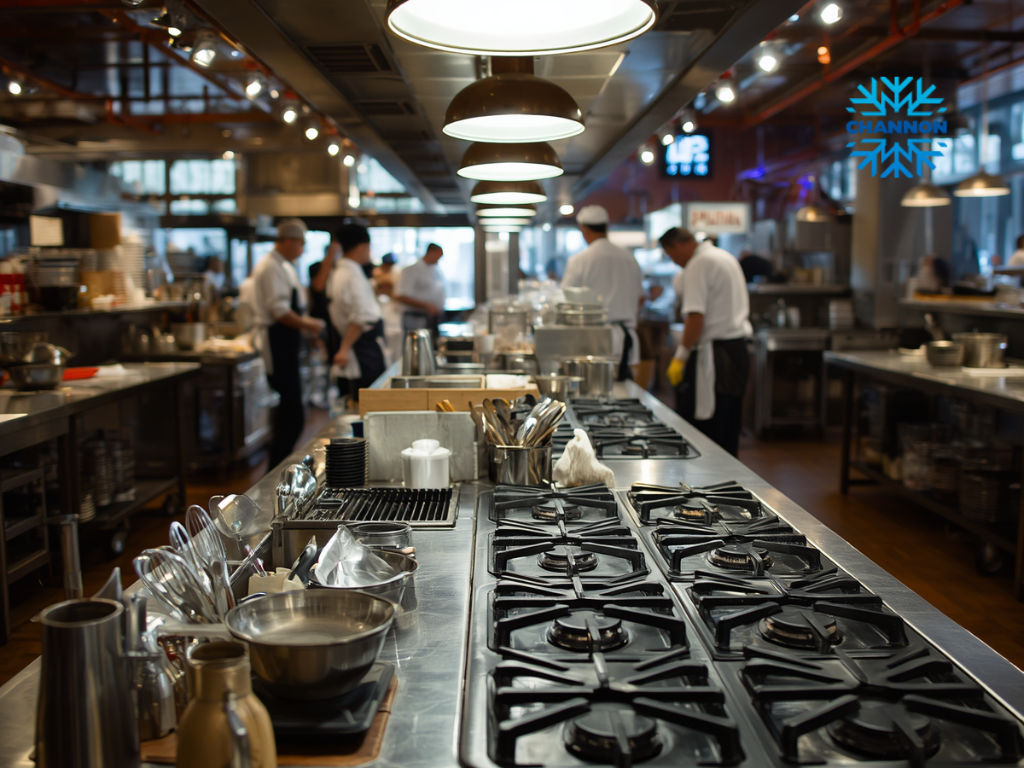
The position of each appliance can affect how quickly staff move through service.
Think about the order of work.
A cook may take prepared food from refrigeration, move it to the range and then transfer it to a plating area.
Another dish may travel from preparation to fryer and then directly to service.
Place related equipment where those movements remain practical.
A commercial deep fryer that sits far from the food preparation area may create unnecessary travel.
The same applies to commercial griddles.
However, do not simply place everything as close together as possible.
Staff still need safe working room.
Doors need to open properly. Handles and controls should remain practical to reach.
The design should also consider how several cooks will use the line at once.
A layout that works for one person may become crowded during peak service.
Leave practical room for cleaning and servicing
Equipment also needs to remain manageable after installation.
Grease, food and spills can collect around commercial cooking appliances.
A layout that makes cleaning difficult can create ongoing problems for kitchen staff.
Consider access to the sides and surrounding surfaces where the equipment design allows it.
Follow the manufacturer’s installation instructions and required clearances.
Service access matters too.
A technician may need to inspect or repair components later.
If another appliance, wall or cabinet blocks that access, servicing can become more complicated.
This is one reason commercial kitchen planning should consider the full equipment line.
Channon’s current design and construction service states that it handles commercial kitchen projects from design through installation and commissioning.
Planning equipment and services together can reduce conflicts between the cooking line and the finished kitchen.
Compare Commercial Cooking Equipment and Suppliers Properly
A low oven price does not necessarily mean a low project cost.
Look at the entire cooking line.
Start with the gas oven.
Then include any fryer, griddle, microwave and rice-cooking equipment the menu needs.
Check whether some appliances duplicate the same function.
For example, buying a large oven plus another oven-based appliance may be unnecessary for a small menu.
On the other hand, a busy restaurant may need both because the two units handle different production tasks.
Businesses searching for commercial cooking equipment sydney should therefore compare equipment as a system.
Review footprint, cooking capacity and service requirements together.
Also consider what equipment can be added later.
A new venue may not need its final production capacity from opening day.
Leaving room for sensible expansion can be more practical than filling every available space immediately.
Review installation, commissioning and after-sales support
A commercial equipment quote should make its inclusions clear.
Check whether it covers equipment only.
Then ask about delivery, installation and commissioning.
Gas work needs appropriately licensed gasfitters in NSW, so clarify who handles that part of the project.
Service support deserves attention as well.
Commercial cooking equipment operates under demanding conditions. Understanding who can inspect or repair it later is useful before buying.
Channon’s current website states that the business supplies commercial cooking equipment and provides design, installation and service support. Its design service covers projects from concept through final installation and commissioning.
Compare quotations on the same basis.
One supplier may quote equipment only.
Another may include more project support.
The total scope matters more than the headline appliance price.
Know When to Contact Channon
Get advice before the final equipment layout is locked in
Channon may be useful when a Sydney business needs to plan several pieces of commercial cooking equipment together.
Its current catalogue includes ovens, cooktops, combination ovens, fryers, griddles and microwave ovens. The broader equipment catalogue also includes rice cookers and other specialist cooking categories.
The company also lists commercial kitchen design and construction services.
Its current design page states that Channon can take a kitchen project from initial design through manufacturing, installation and commissioning.
Contact can therefore be useful before the equipment positions become fixed.
This is especially relevant for a new restaurant, café or catering kitchen.
It may also help when an existing venue wants to replace several appliances at once.
Current product availability, model specifications, gas requirements and project timing should always be confirmed for the individual job.
Prepare menu, site and equipment information before requesting a quote
Start with the menu.
Explain which dishes create the highest cooking demand.
Tell the supplier whether most food is grilled, fried, roasted, baked or cooked in pans.
Next, provide the available kitchen dimensions.
Include doorways and delivery access where large equipment needs to enter the building.
If existing appliances will remain, identify them.
Also share details of the gas and electrical services if you have them.
Do not guess at technical capacity.
A qualified contractor should assess the installation where required.
If you are already considering a 4 burner gas oven, explain why.
Likewise, mention whether you think a commercial deep fryer, commercial griddles, commercial microwave oven or commercial rice cookers will form part of the line.
This gives the supplier a better starting point.
For businesses choosing commercial gas ovens, the key decision is not simply which oven looks best on paper.
The stronger approach is to plan the complete cooking line.
Give each appliance a clear purpose, match capacity to the menu and check the required services before placing the order.
That creates a cooking setup based on how the kitchen needs to work, rather than how much equipment can fit into the room.
